
A cosy read: The Wrong Miss Wilby – Ch 1
A proposal delivered to the wrong sister ought to be corrected at once – unless the error saves a family from scandal.

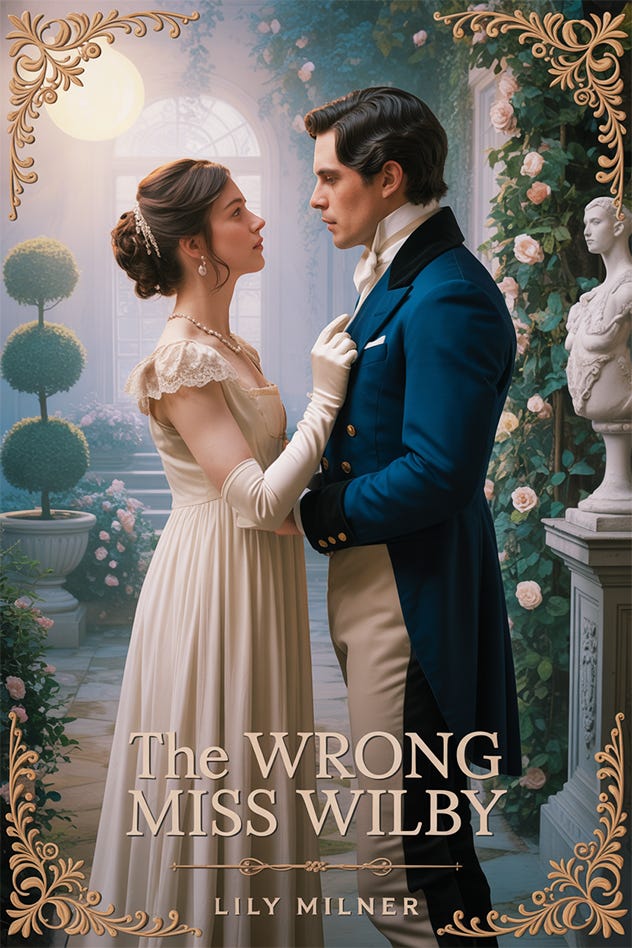
Viscount Robin Linley has promised himself a sensible match with Miss Charlotte Wilby. Unfortunately, he delivers his midnight speech to Charlotte’s twin, Livia, whose smile suggests trouble might be the most sensible thing he’s done in years. With the Season’s sharpest tongues ready to pounce, Livia offers a daring plan: a brief, convenient understanding that shields her sister, calms his aunt, and sends London’s gossip mill spinning in a safer direction.
It should be simple. It never is.
Chapter 1
Livia Wilby had no real intention of marrying him. She only meant to borrow the moment.
The ballroom at Wilby Hall shone as if it had been polished with daylight borrowed for the night. Chandeliers burned steady above the crowd, their waxy halos catching on silk and jet; the air smelled of roses and beeswax. Music laboured dutifully in the gallery while talk rose and fell in gracious waves, each crest breaking on the same reef of speculation: which Wilby sister would be engaged by morning.
Along the eastern wall, where tall mirrors doubled the company into finer versions of themselves, Livia Wilby stood for a moment beneath a spray of hothouse lilies and pretended to admire the arrangement. The pretence allowed her an escape. She had been smiled at, measured, and mistaken for her twin three times since nine o’clock; it is exhausting to be oneself when everyone else insists upon a more convenient person.
Across the room Charlotte laughed at something Lord Ainsley said. They were not entirely identical. Anyone who loved them knew this. But candlelight was a notorious flatterer.
At the threshold, Mrs Wilby conducted arrivals like a general. Her gaze, brisk as a metronome, ticked between daughters and prospects, between prospects and titles. She had a genius for arranging flowers, dinner parties, and destinies; tonight, she meant to do all three.
Viscount Robin Linley arrived without fanfare and tried to remain that way. He had the look of a man who would rather have been anywhere else and who intended to do his duty here nonetheless. His aunt, the formidable Lady Honoria, had pressed his sleeve once before releasing him into the tide. He bowed to Mrs Wilby, said the proper words, and was promptly shepherded to Miss Charlotte – who was, just then, speaking to someone else.
The quadrille began; the floor shook itself into order. Livia took a place she had not been meant to take and caught, just for a heartbeat, a gentleman watching only her, not the version of her that the room preferred. He looked away as if the sight had startled him. Later, she would learn the name for that startle. For now, she turned her face back to the dance and did not trip.
Between figures, the curtains shivered with the night air and the scent of the garden slipped in – peonies, damp gravel, the cool shadow under a walnut’s spreading arms. Somewhere, in the card room beyond the double doors, a laugh broke too sharp and then was smothered; somewhere, on the terrace, a pair of great-aunts took the air and minded everybody’s business.
When the waltz ended, Robin found that the room had narrowed to a single purpose. It is a curious thing, how a life can feel both settled and entirely unbegun. He asked for an introduction he already had. He asked for a turn he did not need. And when the moment came to walk out into the garden, he followed a whisper of silk that belonged, he thought, to a certainty.
The chandeliers burned on. The musicians played. The mirrors held their reflections. And the house prepared itself to remember the night it made a mistake on purpose.
It was, to begin with, the wrong garden.
Viscount Robin Linley realised this somewhere between the walnut tree and the ironwork gate, where moonlight sifted through leaves and perfumed air teased him with roses. He had practised his speech three dozen times – the unadorned, honourable sort a gentleman makes when both hearts and fortunes must be considered – and he had chosen, with a caution bordering on cowardice, the quieter Miss Wilby, because quiet suited him. He had even selected the darkest path, so he needn’t see his own apprehension too clearly.
The lady upon his arm laughed – softly, warmly, and not at all as he remembered.
‘I am not a man of many words,’ Robin began, and discovered immediately that he had far too many. ‘I mean – I have words, only they are not the right sort. Miss Wilby – Miss Charlotte – would you allow me –’
He was handsome, in an overly serious way, Livia decided. Dark-haired, strong jaw, brows knit with concentration as if love were a contract he meant to negotiate rather than feel. He took her hand and drew her closer – Charlotte’s hand, technically. That was the moment when she should have laughed and shared the joke. Would he blush, step back in horror, or simply look mortified when he realised his mistake? But Viscount Robin Linley did none of those things.
It was the moon she thought later. They were in the deepening shadow of the old walnut tree when the moon broke free from the clouds and washed them both in magic light. His face was suddenly all strong lines and his lips looked delectably soft. His eyes widened, as if seeing her for the first time. Perhaps he was. They had met only an hour ago and all his attention then had been fixed on Charlotte. Now, however, he was looking at her in a way that no man had ever been allowed to do before. They might have been alone in a wilderness where anything would be allowed to happen. Her body throbbed with longing, and she knew he no doubt felt the same.
He bent forward. ‘Marry me Miss Wilby,’ he breathed. It was a simple command, not a proposal, and before she could speak he had pulled her into his arms and was kissing her, not a gentle meeting of their lips to seal the pact, but a deeply passionate, sensuous coming together that roused feelings Livia had no idea she had.
She should have pushed him away, her mind told her it was wrong, but her body had other ideas, and her response was to pull him closer and move her lips to his in a passionate rhythm. It must never end, this feeling of belonging. It must last forever.
Oh dear. This had not been part of the plan.
Robin Linley had faced cavalry in the Peninsula War, near-starved auditors in his father’s counting house, and the mortifying experience of being the last man in his club to discover that his breeches had come unstitched at the back.
None of that had prepared him for the sensation of kissing a young lady in the garden, only to discover that she wasn’t the lady he intended. Not that she’d said as much. In fact, she hadn’t corrected him at all. She’d stood beneath the walnut tree with a smile that curled like ribbon, eyes bright with anticipation, lips parted in a way that promised, well …
What had gone wrong? He’d rehearsed his proposal – simple, practical, carefully worded. It started properly. But something odd happened. The moonlight.
They quickly separated and moved away from the walnut’s shadow.
‘Miss Charlotte …’ He began, an apology ready on his tongue.
Crickets stitched a steady rhythm while the house promised music and warm chatter behind them. She turned her face toward him and the obliging moon gave him the smallest correction of light.
‘Miss Charlotte?’ she echoed, amusement glinting in her eyes.
Not Charlotte.
The resemblance would trouble any portraitist: the same mouth, the same sweep of brow, the same elegant line of neck. But where Miss Charlotte Wilby wore demureness like pearls, this sister’s eyes were a little wicked, as if the night had told her a joke and she waited for him to catch it.
‘I must beg your pardon. Miss Wilby –’
‘Livia,’ she offered. ‘If we are to continue wandering secret corners of my mother’s garden, we had best be honest.’
‘Yes. Honesty,’ he managed, ‘is precisely what is wanted here.’
‘And yet,’ she said, head tilting, ‘you look as though you’ve mislaid it.’
He had. He’d misplaced it near the terrace when a family friend smiled encouragingly and herded him toward a Wilby sister. There were two. He had meant the other. He had not accounted for twins, moonlight, and the unnerving sensation of being understood before he’d said anything at all.
‘Miss – Livia,’ he corrected, and his voice steadied. ‘I must apologise. I sought your sister.’
‘That is a beginning,’ she said. ‘Will you continue?’
‘I came to ask for her hand. There are reasons – good ones.’ He cleared his throat. ‘Respectable reasons.’
‘Respectable reasons generally wear very heavy boots,’ Livia said. ‘Do they trample feelings on their way to the altar?’
‘They avoid feelings altogether,’ Robin returned. ‘Feelings are unreliable. Inheritance is not.’
She laughed at that, quieter now, with a seam of sympathy running through it. ‘I see. A sensible man in search of a sensible connection.’
‘Yes.’
‘And you mistook me for Charlotte.’
‘Yes.’
‘Yet you have continued walking with me into the dark rather than fleeing back to the ballroom to begin again.’
He had no adequate defence for that. What had just happened between them was unforgivable, but also unavoidable. Even now the feeling that something stronger than moonlight and that last brandy – meant to give him courage – had prompted him to throw all caution to the gathering winds.
A gust off the lawns set the roses nodding. Livia shivered. Robin offered his coat. She shook her head. ‘If we are very proper,’ she said, ‘you must walk me back at once.’
‘If we are very proper,’ he said, ‘I must find your sister.’
‘And if we are sensible?’ Her mouth curved. ‘There may be a path where both aims align.’
He ought to have bowed, begged pardon, and removed himself to the correct garden path. Instead, he said, ‘Explain.’
‘My mother desires Charlotte to marry a title; Charlotte desires to marry when she has finished being eighteen, which may take years; and you, my lord, desire not to be hunted by every mama in London for the remainder of the Season.’ Her mischievous eyes met his. ‘You require a reprieve. We could contrive one.’
‘You propose a deception?’
‘I propose a shield. There is a distinction,’ she said. ‘A brief, entirely convenient understanding. You may declare yourself – vaguely – engaged to a Miss Wilby. No first name need appear for a day or two. You will be spared pursuit; Charlotte will be spared pressure; and I will be spared my mother’s lectures on the perils of ‘languishing unchosen.’’
Robin stared. ‘You would put yourself at the mercy of gossips for our comfort?’
‘I would put myself,’ Livia said lightly, ‘in the way of adventure. Also, I should like to choose my future just as much as Charlotte wishes to choose hers. This buys us both time.’
‘It would be dishonest.’
‘It would be … expedient,’ she allowed. ‘And kinder, perhaps, than letting the entire London ton tug at us like a bell-rope.’
‘Livia,’ he said slowly, ‘you must not make light of your good name.’
‘I do not,’ she returned. ‘I am making a strategy of it.’
He thought of the tall windows where matrons watched the dark with predatory serenity. He thought of his aunt, practical as account books; of the estates that required an heir; of the promise he had made to be dull and dutiful and, if necessary, content. He thought, traitorously, of how Livia’s voice made the night sound interesting and how her lips had promised more than words.
‘Two days,’ she said gently, as if she felt the tilt of his thoughts. ‘We declare our intentions, in the vaguest terms; you consult your aunt, Charlotte is spared, I tell my mother I have done something decisive, and she faints and is revived with ratafia. At the end of it we gracefully bow out. No harm done.’
‘And if harm arrives uninvited?’
‘Then we face it together and send it away without tea.’
He laughed. ‘You would be very dangerous if you were unkind.’
‘I am dangerously kind,’ Livia said. ‘Ask anyone who has tried to refuse my cakes.’
Robin looked down at the hand on his sleeve. ‘Very well,’ he said, and felt the ground tilt and settle under a new resolution. ‘Two days.’
‘Excellent.’ She squeezed his arm, brisk as a co-conspirator. ‘We shall be perfectly proper. We shall also, I suspect, have a great deal of fun.’
‘Fun,’ he echoed, as if it were a language he had once known. ‘I suppose one must begin sometime.’
They turned toward the terrace where light and rules awaited them. At the balustrade, the ballroom fanned open into gold and motion: ladies like blossoms, gentlemen like dark stems with the orchestra unfurling a new waltz. Conversation swelled when they entered together – the first inquisitive ripple.
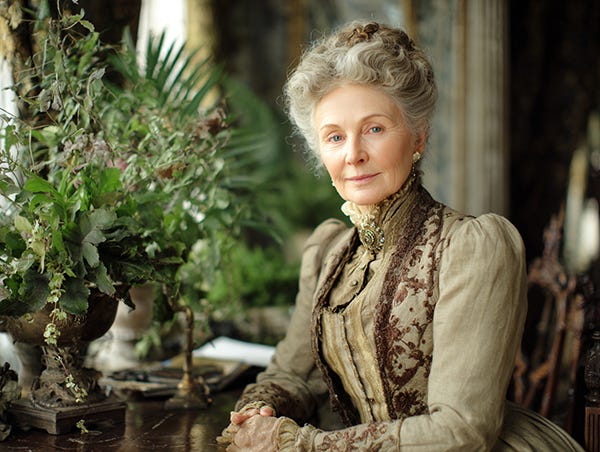
Aunt Honoria intercepted them with the accuracy of a general. She was a slight woman composed entirely of principles and hairpins. ‘Robin,’ she said, in the tone that suggested she forgave him in advance for whatever he had done. ‘Miss Wilby.’
Livia curtsied. ‘How do you do, Lady Honoria. You will forgive us – we have been admiring your nephew’s judgment.’
Aunt Honoria’s brows rose. ‘His judgment?’
‘In selecting the precise length of a garden stroll,’ Livia said. ‘Any longer and we should have caught a chill. Any shorter and we should have caught the cotillion.’
‘Mm.’ Aunt Honoria’s gaze sharpened. ‘And did you discuss the weather for the entire duration?’
‘We were quite brave,’ Livia said solemnly. ‘We ventured as far as philosophy.’
‘Philosophy,’ Aunt Honoria repeated. ‘I am unsurprised.’ She turned to Robin. ‘Your uncle will wish to know whether your philosophical conclusions will require jewels.’
Livia’s lips twitched. ‘I hope they will require patience instead.’
‘Miss Wilby,’ the aunt said, after the smallest pause, ‘one may have both.’
The orchestra swelled. Livia looked up at Robin. ‘Shall we be perfectly proper, my lord?’
‘We had better begin as we mean to go on,’ he murmured, and led her to the floor.
They took their places. The first turn was cautious, the second almost graceful. By the third, she had him laughing again – quietly, incredulously, as if he had discovered a small corridor in himself where ease lived. Around them the room blurred to candlelight and silk. Livia’s hand in his was cool and steady.
‘Two days,’ she reminded him under the music.
‘Two days,’ he agreed, and tried not to wonder what the third would demand.
On the far side of the room, Miss Charlotte Wilby watched with unruffled politeness, the sort that suggests unshakeable good sense or profound boredom. Their mother – magnificent and alarmingly pleased – whispered to a friend whose feathers trembled in sympathetic delight. A gentleman of uncertain scruples took out a betting book.
The waltz turned. Livia’s gaze met Robin’s, bright as a dare and kind as a promise. If this was a shield, it felt suspiciously like the beginning of a story.
And it was, of course, the wrong garden that had begun it. Which may be the only right thing about it.
Next: The Wrong Miss Wilby – Chapter 2